


French Press Espresso-Style Coffee Preparation
Aug
Kahve dünyasında demleme yöntemleri, her birinin kendine özgü karakteristik özellikleriyle farklı lezzet profilleri sunar. Bu yazıda, French Press kullanarak espresso benzeri yoğun ve aromatik bir kahve hazırlama tekniklerini, bilimsel temelleriyle birlikte inceleyeceğiz. For those who want to enjoy an intense, full-bodied, and satisfying coffee experience without an espresso machine at home, this guide provides a step-by-step actionable roadmap.
Espresso ve French Press Kavramları
Espresso Nedir?
Espresso is a concentrated coffee drink made by passing hot water under high pressure (usually 9 bar) through a layer of finely ground coffee. In this method, approximately 30 ml of intense coffee is obtained as a result of a short extraction time of 25-30 seconds. The most distinctive feature of espresso is crema, which is a layer of golden brown foam that forms on its surface. This foam is formed as a result of the release of oils and carbon dioxide in coffee and is one of the freshness indicators of coffee.
What is French Press?
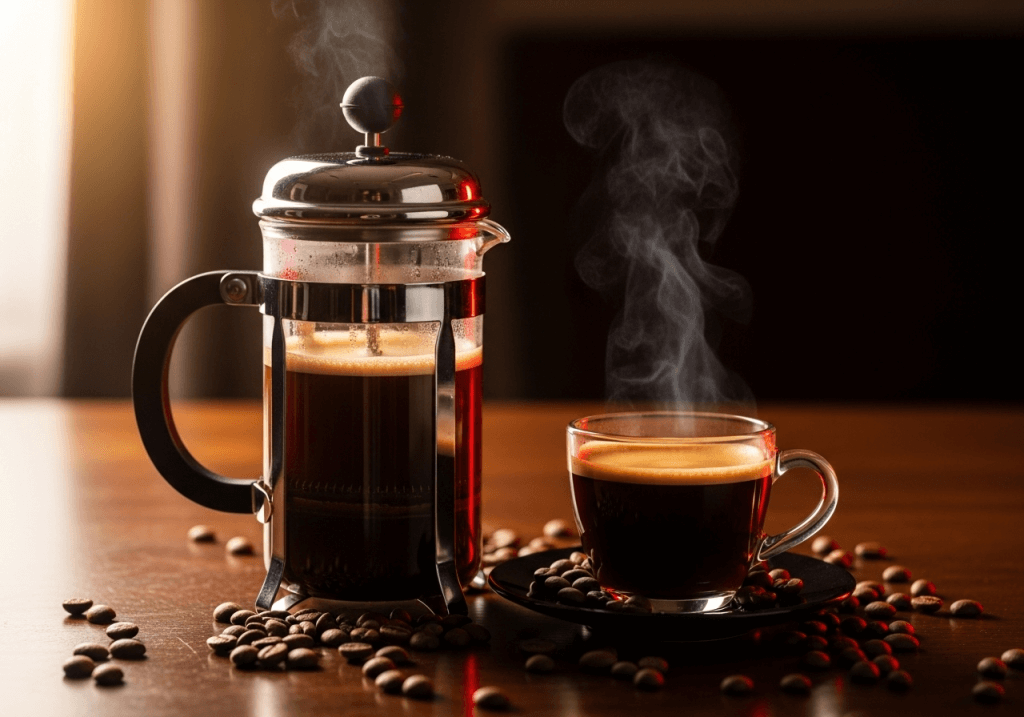
French Press is an immersion brewing method patented by Attilio Calimani in 1929. In this system, medium-thick ground coffee comes into direct contact with hot water and is left to brew for a certain period of time. Coffee grounds and liquid coffee are separated from each other by means of a metal filter piston. The main advantage of the French Press is that it retains the natural oils and aromatic components of the coffee, providing a full-bodied drink. Brewing in a French Press using bean coffee is one of the most ideal methods for preserving aromas.
Differences Between the Two Methods
The fundamental differences between espresso and French Press can be summarized as follows:
- Pressure: Espresso uses high pressure, while French Press works with gravity and manual pressure.
- Grind thickness: Espresso requires a very fine grind, while the French Press uses a medium-coarse grind.
- Brewing time: Espresso requires 25-30 seconds of brewing, while French Press requires 4-5 minutes.
- Concentration: Espresso is intense and concentrated, while French Press is a more dilute drink.
Required Equipment and Materials
Basic Equipment
Choosing a French press
Features to consider when choosing a French Press for espresso-like results:
- Material: Double-walled stainless steel or borosilicate glass for heat insulation
- Filter system: Multi-layered metal filter system should be preferred
- Capacity: 350 ml for single use, 1 liter for multiple servings
Grinder Types
The use of a conical mill grinder (burr grinder) is critical for rough grinding. These grinders come in two types:
- Conical burr: Produces less heat, preserves aromas.
- Flat burr: Provides more consistent particle size.
Blade grinders should be avoided because inconsistent grind size leads to extraction problems. Grind quality is one of the most important factors that directly affect the flavor of the coffee in your cup.
Measurement Tools
- Digital scale: For measurement with 0.1 gram precision
- Thermometer: For water temperature control
- Stopwatch: For brewing time tracking
Coffee Bean Selection
To achieve an espresso-like result in the French Press, intensely flavored coffee beans should be preferred. Beans with medium-dark roast profiles give ideal results in terms of both body and density.
Choosing Water
Using filtered water reveals the true aromas of coffee. Water characteristics:
- pH: Between 6.5-7.5
- Total dissolved solids (TDS): 150-200 ppm
- Chlorine-free and odorless

Preparation Phase
Pre-heating the French Press
To minimize heat loss, heat the French Press with hot water before use. This process:
- Fill the French Press with boiling water.
- Wait 30 seconds.
- Drain the water and pat dry.
Grinding Process
Grind Size
For an espresso-style result, a medium-fine grind should be aimed for, which is finer than the standard French Press grind but coarser than the espresso grind. This is a thickness between a grain of salt and fine sand. As we detailed in our Coffee Grinding Guide for Moka Pot article, the grinding thickness directly affects the extraction time.
Grinding Consistency
Consistent particle size ensures balanced extraction. Things to consider when grinding:
- Grind at a constant speed.
- Keep the grinder clean.
- Use the same settings for every use.
Brewing Process
Measurement and Blooming
Coffee-to-Water Ratio
For espresso-like intensity, the coffee-to-water ratio should be 1:10 or 1:12. For example:
- 300-360 ml water for 30 grams of coffee
Blooming Technique
Blooming is the pre-wetting process that releases carbon dioxide in coffee. This step allows the extraction to occur more efficiently:
- Add 2 times the amount of water (60 ml) to the amount of coffee.
- Mix gently.
- Hold for 30-45 seconds.
- Observe the blistering coffee surface.
Brewing and Pressing
Water Temperature
Optimal water temperature is between 92-96°C. Higher temperatures cause bitterness, while lower temperatures result in insufficient extraction.
Brewing Time
For espresso-like intensity, brewing time should be 2.5-3 minutes:
- Add the remaining water after flowering.
- Cover up. (without lowering the piston)
- Wait 2.5-3 minutes.
Pressing Technique
The pressing technique directly affects the result:
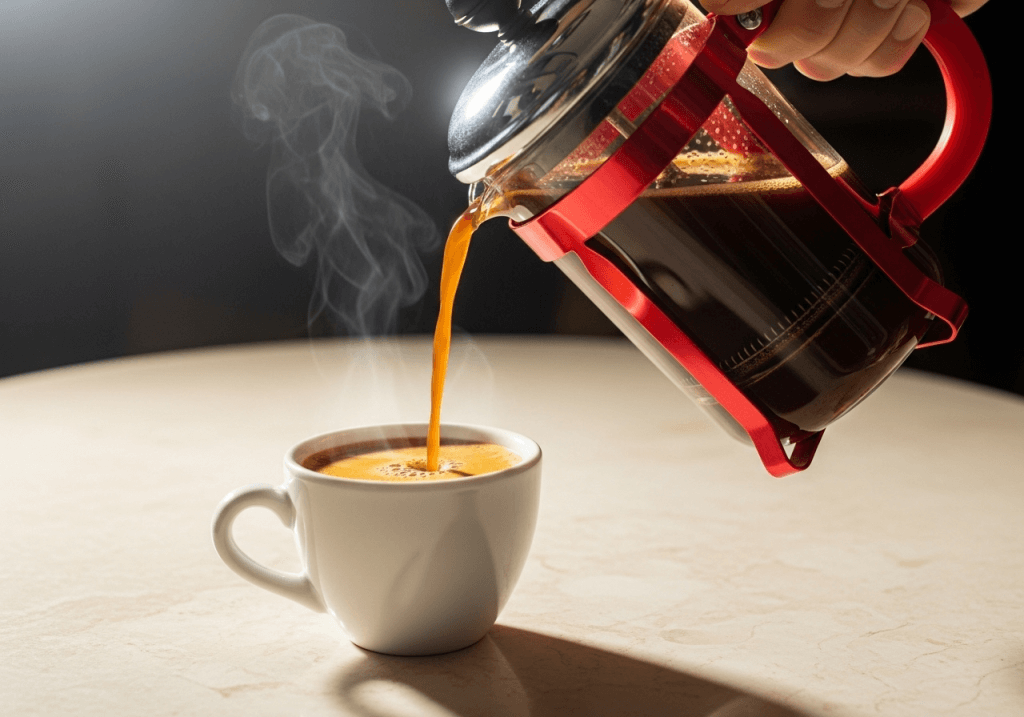
- Lower the piston at a slow and steady speed. (15-20 seconds)
- If you encounter resistance, pull the plunger up slightly and lower it again.
- Serve immediately after it is completely landed.
Serving
Serve the prepared coffee immediately in preheated coffee cups . Holding can cause oxidation and temperature loss, negatively impacting the flavor profile of the coffee.
Perfection Tips
Bean Freshness
- Store kernels in airtight, opaque containers.
- Do the grinding just before brewing.
- As we mentioned in our article The Secret of Brewing 2 Times Stronger Coffee at Home, the coffee-water ratio and brewing time are the most critical factors that determine the density.
Grind Size Consistency
Inconsistent grind size causes different extraction rates:
- Fine particles cause over-extraction (bitterness)
- Coarse particles cause under-extraction (sourness)
Temperature Control
Considerations for temperature stability:
- Preheat the French Press.
- Check the water temperature with a thermometer.
- In cold environments, extend the brewing time by 15-30 seconds.
Trial and Adjustment
Every coffee is different. Find your ideal through systematic experimentation:
- Follow the basic recipe.
- Change one variable at a time.
- Take notes.
- Compare by tasting.
Common Mistakes and Solutions
Over-extraction
Symptoms: Bitter, burnt, ashy taste
Solutions:
- Reduce the water temperature by 2-3°C.
- Shorten the brewing time by 15-30 seconds.
- Use coarser grinding.
Under-extraction
Symptoms: Sour, watery, unflavored
Solutions:
- Increase the water temperature by 2-3°C.
- Extend the brewing time by 15-30 seconds.
- Use finer grinding.
Inconsistent Grind Size
Symptoms: Both bitter and sour notes
Solutions:
- Use a quality miller’s grinder (burr grinder).
- Clean the grinder regularly.
- Adjust the burrs.

Advanced Techniques and Variations
Secondary Filtration
Methods that can be applied for a cleaner cup:
- After the French Press, pass it through a paper filter.
- Use a metal mesh filter.
- Apply decantation. (slowly transfer the coffee to another container)
Aroma Enhancement
Techniques that can be applied to improve extraction efficiency:
- Mixing technique: Mix in the form of 8 after flowering.
- Temperature profile: High temperature in first half, low temperature in second half
- Bypass brewing: Adding water after concentrated brewing
Personal Blends
Blend recommendations for espresso-like profile:
- 60% Brazil (body and chocolate notes)
- 30% Colombia (balance and sweetness)
- 10% Ethiopia (complexity and fruit notes)
100% Arabica coffee varieties offer an excellent starting point for achieving espresso-like results in a French Press.
Conclusion
Espresso-style coffee preparation with a French Press is a good example of overcoming equipment limitations with creative techniques. The key to success in this method is to keep every variable under control and to find your personal preference through systematic trial and error. With the right bean selection, ideal grinding thickness, appropriate water temperature and precise timing, it is possible to have an intense, aromatic and satisfying coffee experience without an espresso machine at home. Remember, perfect coffee is subjective, and discovering the perfect one for your taste buds (palate) is a delightful journey.
En Çok Satan Kampanyalarımız
₺ 1.720,00Original price was: ₺ 1.720,00.₺ 1.548,00Current price is: ₺ 1.548,00.₺ 1.215,00Original price was: ₺ 1.215,00.₺ 1.093,00Current price is: ₺ 1.093,00.₺ 1.175,00Original price was: ₺ 1.175,00.₺ 1.057,00Current price is: ₺ 1.057,00.₺ 1.855,00Original price was: ₺ 1.855,00.₺ 1.670,00Current price is: ₺ 1.670,00.₺ 2.235,00Original price was: ₺ 2.235,00.₺ 1.900,00Current price is: ₺ 1.900,00.